Innovative composite performance
solution built on the T-Link® Platform.
TOUGHER COMPOSITES. SMARTER PROCESSING.
Toughened T-Link® enables composite manufacturers to make layered epoxy carbon-fiber structures tougher, more impact damage resistant, and easier to process by combining high ductility, impact performance, and energy absorption with the handling, storage, and consolidation advantages of thermoplastic adhesive technology.
CHALLENGES
Lightweight composite laminates can be vulnerable to matrix cracking and interlaminar delamination following impact. The extent of internal damage can reduce residual strength even when surface damage is not obvious.
Toughened T-Link® can be positioned at selected interfaces within a laminate to modify the interlaminar response without replacing the complete epoxy matrix system.
Key areas of focus include:
- Damage tolerance
- Impact resistance
- Performance retention after damage
- Laminate durability
- Manufacturing efficiency
The T-Link® Difference – ENGINEERED INTO THE LAMINATE
HOW TOUGHENED T-LINK® WORKS AND PERFORMS
HOW IS TOUGHENED T-LINK® INTEGRATED ACROSS THE COMPONENT?
Toughened T-Link® film L-F620 can be incorporated continuously across the component area at one or more selected ply interfaces. This creates a full-area thermoplastic interlayer within the laminate while preserving the primary epoxy matrix and continuous-fiber reinforcement.
WHICH MATERIALS HAS TOUGHENED T-LINK L-F620 BEEN DEMONSTRATED TO BOND?
Available testing demonstrates Toughened T-Link® film L-F620
bonding to
- Prepared galvanized steel
- 17-4 stainless steel
- Ti-6Al-4V
- LMPAEK composite-to-stainless-steel assembly
- NCT 301/CF laminate
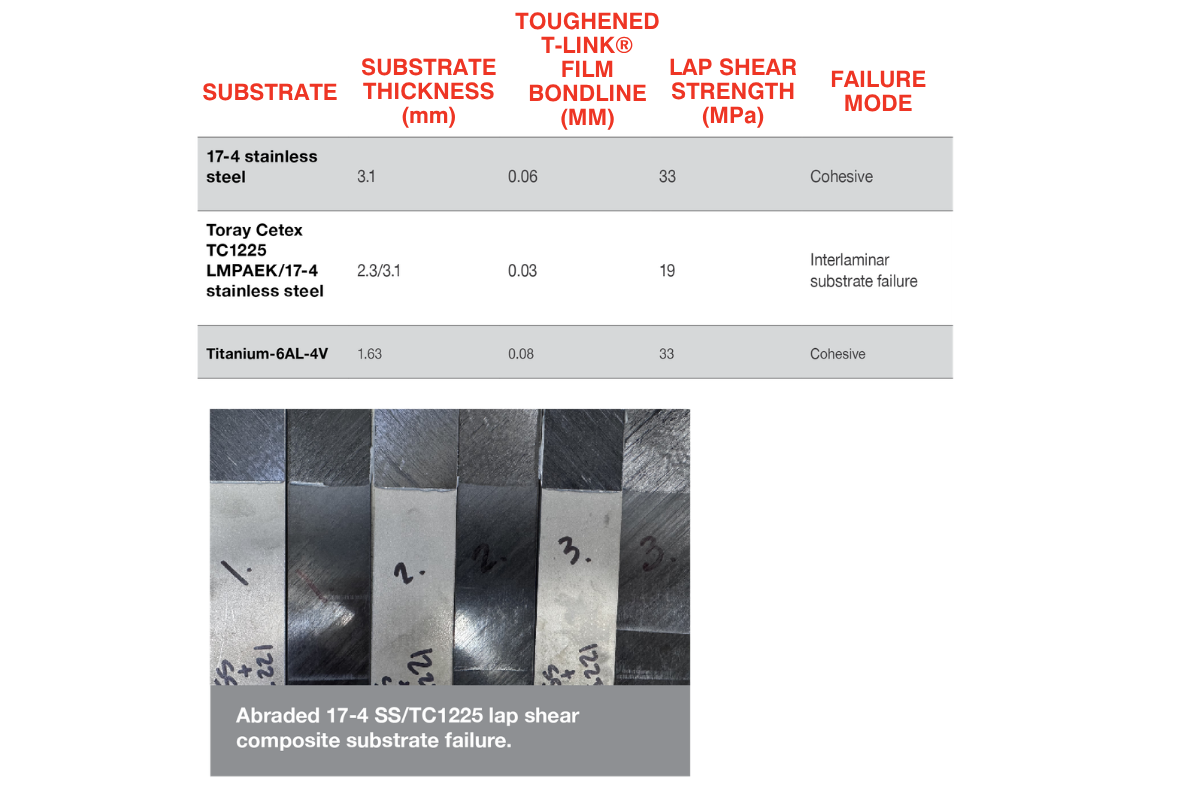
Cohesive failure was observed in the stainless-steel and titanium joints, while the TC1225 LMPAEK hybrid joint failed within the composite substrate rather than at the bonded interface.
WHAT LAP-SHEAR PERFORMANCE HAS TOUGHENED T-LINK® FILM L-F620 DEMONSTRATED?
|
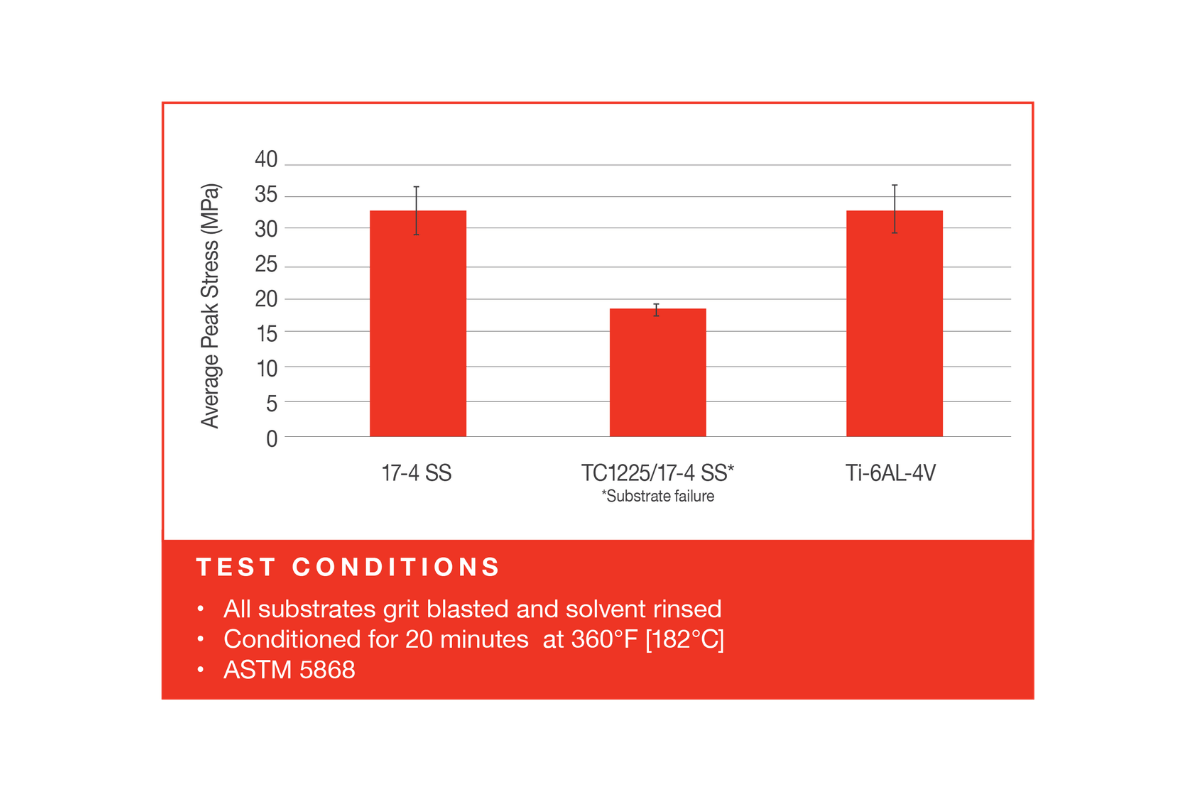
Toughened T-Link® film L-F620 achieved average apparent lap-shear stresses of 33 MPa on prepared 17-4 stainless-steel and Ti-6Al-4V joints, with cohesive failure. A TC1225 LMPAEK composite-to-17-4 stainless-steel joint reached 19 MPa before failing within the composite substrate. The T-Link selection data also reports a typical L-F620 lap-shear range of 18–25 MPa on HD-G60 galvanized steel. The 17-4, titanium and TC1225 joints used grit-blasted and solvent-rinsed substrates and were processed for 20 minutes at 182°C. Results depend on joint geometry, bondline thickness, surface preparation and processing conditions. |
 |
 |
WHICH COMPOSITE SYSTEMS HAS T-LINK BEEN EVALUATED TO WORK WITH?
Composite architectures, resin chemistries and manufacturing processes vary widely. Current T-Link technical materials include the following examples:
- Epoxy/carbon-fiber laminates evaluated through compression-after-impact and short-beam testing
- S-2 glass reinforcement examined for fiber wet-out
- Aramid reinforcement represented by Toughened T-Link® pellets L-TE20-coated aramid yarn
- Some UHMW-PE materials identified as potential co-processing candidates
The depth of available evidence varies by material system. Carbon-fiber/epoxy has mechanical test results, S-2 glass has representative microscopy, and the aramid and UHMW-PE references describe product or application compatibility rather than equivalent structural-performance testing.
These examples are starting points—not an exhaustive compatibility list. T-Link performance depends on the matrix chemistry, reinforcement, laminate architecture, material placement and consolidation process.
WORKING WITH A DIFFERENT COMPOSITE SYSTEM? Share your reinforcement, resin or prepreg system, processing conditions and performance objectives with our applications team. We can help review the integration requirements and identify an appropriate evaluation path.
Discuss Your Composite System
DOES TOUGHENED T-LINK® FILM L-F620 HELP A LAMINATE RETAIN STRENGTH AFTER IMPACT?
|
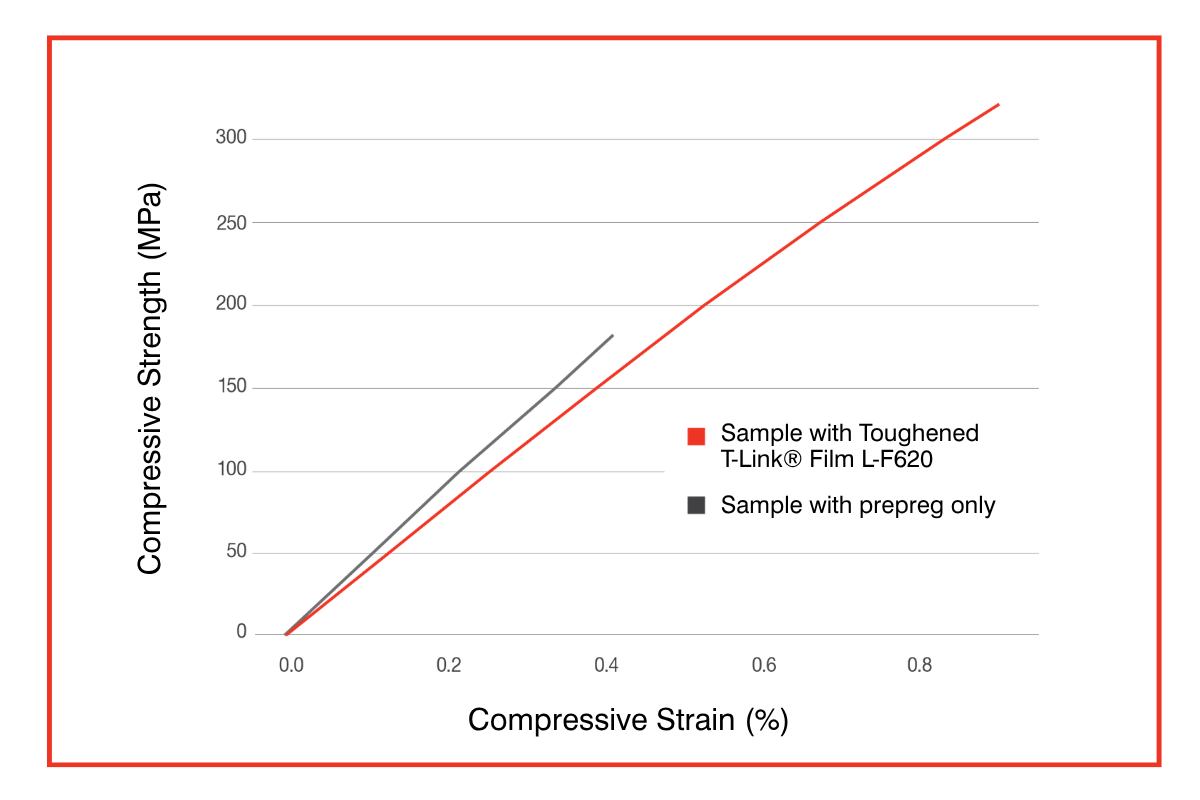
ASTM TEST PERFORMED BY NIAR Under the reported test conditions, carbon-fiber/epoxy panels incorporating Toughened T-Link® film L-F620 demonstrated 66% higher compression-after-impact strength than prepreg-only panels. +66% Compression-after-impact strength Tested configuration: Toughened T-Link® film L-F620 incorporated into a carbon-fiber/epoxy prepreg laminate and compared with a prepreg-only control. |
 |
DOES TOUGHENED T-LINK® FILM L-F620 PROMOTE A MORE PROGRESSIVE INTERLAMINAR RESPONSE?
|
In ASTM D2344 short-beam testing, the laminate containing Toughened T-Link® film L-F620 sustained its load-carrying response over greater crosshead displacement than the prepreg-only control. The result indicates a more progressive deformation response rather than an abrupt early loss of load. Tested configuration: NCT301 laminate containing Toughened T-Link® film L-F620, compared with an NCT301-only control and alternative thermoplastic interlayers. |
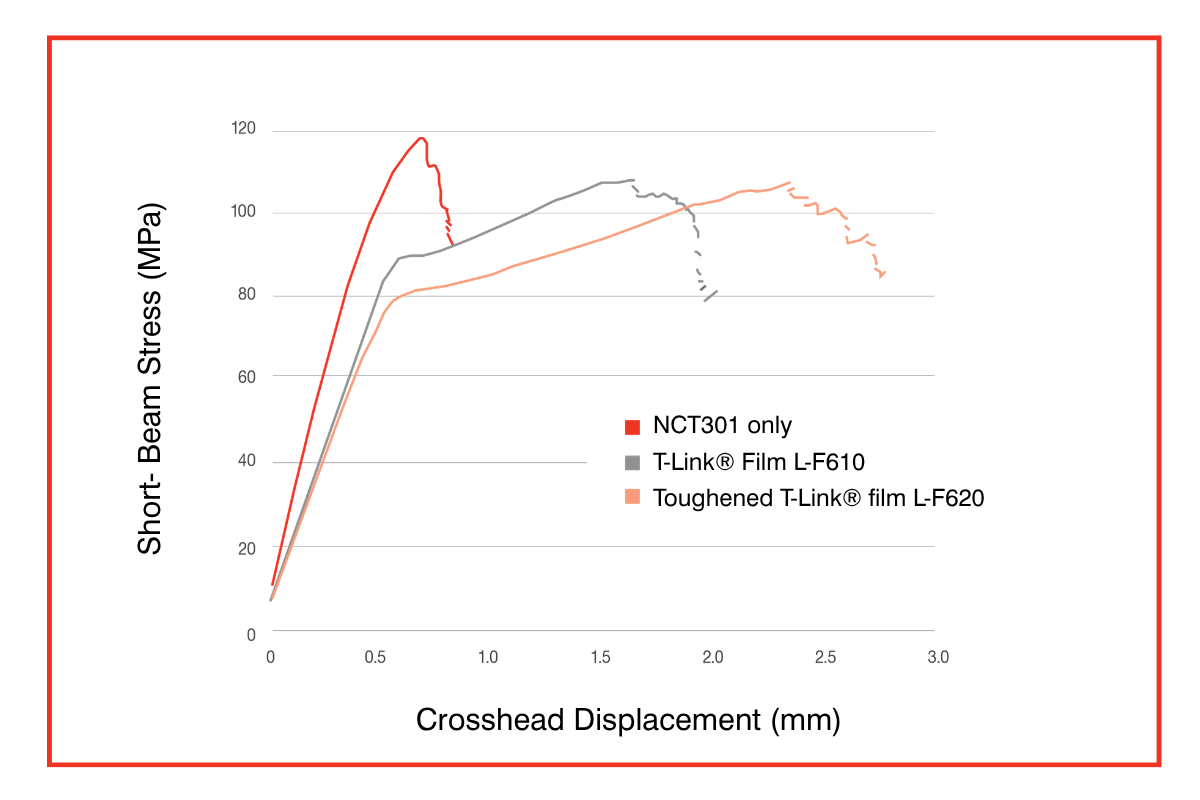 |
CAN T-LINK CONSOLIDATE WITH COMPOSITE REINFORCEMENT?
A representative cross-section of a T-Link/carbon-fiber composite shows resin distributed around the fiber reinforcement, indicating good fiber wet-out. No voids are visible within the area shown.
5 mil T-Link film, 40 wt% reported resin content
The image provides qualitative evidence from the inspected cross-section. Overall laminate void content and consolidation quality should be evaluated across multiple locations.
View microstructure details
HOW IS TOUGHENED T-LINK® INTEGRATED ACROSS THE COMPONENT?
Toughened T-Link® film L-F620 can be incorporated continuously across the component area at one or more selected ply interfaces. This creates a full-area thermoplastic interlayer within the laminate while preserving the primary epoxy matrix and continuous-fiber reinforcement.
WHICH MATERIALS HAS TOUGHENED T-LINK L-F620 BEEN DEMONSTRATED TO BOND?
Available testing demonstrates Toughened T-Link® film L-F620
bonding to
- Prepared galvanized steel
- 17-4 stainless steel
- Ti-6Al-4V
- LMPAEK composite-to-stainless-steel assembly
- NCT 301/CF laminate
Cohesive failure was observed in the stainless-steel and titanium joints, while the TC1225 LMPAEK hybrid joint failed within the composite substrate rather than at the bonded interface.
WHAT LAP-SHEAR PERFORMANCE HAS TOUGHENED T-LINK® FILM L-F620 DEMONSTRATED?
Toughened T-Link® film L-F620 achieved average apparent lap-shear stresses of 33 MPa on prepared 17-4 stainless-steel and Ti-6Al-4V joints, with cohesive failure.
A TC1225 LMPAEK composite-to-17-4 stainless-steel joint reached 19 MPa before failing within the composite substrate.
The T-Link selection data also reports a typical L-F620 lap-shear range of 18–25 MPa on HD-G60 galvanized steel.
The 17-4, titanium and TC1225 joints used grit-blasted and solvent-rinsed substrates and were processed for 20 minutes at 182°C. Results depend on joint geometry, bondline thickness, surface preparation and processing conditions.
WHICH COMPOSITE SYSTEMS HAS T-LINK BEEN EVALUATED TO WORK WITH?
Composite architectures, resin chemistries and manufacturing processes vary widely. Current T-Link technical materials include the following examples:
- Epoxy/carbon-fiber laminates evaluated through compression-after-impact and short-beam testing
- S-2 glass reinforcement examined for fiber wet-out
- Aramid reinforcement represented by Toughened T-Link® pellets L-TE20-coated aramid yarn
- Some UHMW-PE materials identified as potential co-processing candidates
The depth of available evidence varies by material system. Carbon-fiber/epoxy has mechanical test results, S-2 glass has representative microscopy, and the aramid and UHMW-PE references describe product or application compatibility rather than equivalent structural-performance testing.
These examples are starting points—not an exhaustive compatibility list. T-Link performance depends on the matrix chemistry, reinforcement, laminate architecture, material placement and consolidation process.
WORKING WITH A DIFFERENT COMPOSITE SYSTEM? Share your reinforcement, resin or prepreg system, processing conditions and performance objectives with our applications team. We can help review the integration requirements and identify an appropriate evaluation path.
Discuss Your Composite System
DOES TOUGHENED T-LINK® FILM L-F620 HELP A LAMINATE RETAIN STRENGTH AFTER IMPACT?
ASTM TEST PERFORMED BY NIAR
Under the reported test conditions, carbon-fiber/epoxy panels incorporating Toughened T-Link® film L-F620 demonstrated 66% higher compression-after-impact strength than prepreg-only panels.
+66% Compression-after-impact strength
Tested configuration: Toughened T-Link® film L-F620 incorporated into a carbon-fiber/epoxy prepreg laminate and compared with a prepreg-only control.
DOES TOUGHENED T-LINK® FILM L-F620 PROMOTE A MORE PROGRESSIVE INTERLAMINAR RESPONSE?
In ASTM D2344 short-beam testing, the laminate containing Toughened T-Link® film L-F620 sustained its load-carrying response over greater crosshead displacement than the prepreg-only control. The result indicates a more progressive deformation response rather than an abrupt early loss of load.
Tested configuration: NCT301 laminate containing Toughened T-Link® film L-F620, compared with an NCT301-only control and alternative thermoplastic interlayers.
CAN T-LINK CONSOLIDATE WITH COMPOSITE REINFORCEMENT?
A representative cross-section of a T-Link/carbon-fiber composite shows resin distributed around the fiber reinforcement, indicating good fiber wet-out. No voids are visible within the area shown.
5 mil T-Link film, 40 wt% reported resin content
The image provides qualitative evidence from the inspected cross-section. Overall laminate void content and consolidation quality should be evaluated across multiple locations.
View microstructure details
Disclaimer:
TESTING TRANSPARENCY: Results are specific to the materials, laminate constructions, surface preparations and processing conditions evaluated. Typical values are not product specifications. Customers should validate T-Link performance in their own material systems and manufacturing processes.
RESOURCES
Learn more about T-Link
Download L&L Products resources on Toughened T-Link® and find out more about the enabling technology that can help you go beyond limits.
Follow the T-Link® LinkedIn page for technology updates and recent applications.
EVENTS
meet us